Family-run since 2010 • Plumbing in Greater Cleveland since 1992
AC Installation & Replacement in Brunswick, OH
Last updated:
Sized for your house, not for the box on the truck. We'll tell you where the money is worth spending in a climate that only asks for cooling three months a year.
Hours: Call for availability
Ask about a new system
Tell us what the house is doing and we'll call you back to set a time. Hours: Call for availability.
How much does central air cost installed in Northeast Ohio?
A straight condenser-and-coil replacement on existing ductwork and line set in Greater Cleveland typically runs $4,500 to $8,000. Larger tonnage, a high-efficiency tier, a new line set, or electrical and duct corrections push it toward $10,000 and beyond. Adding central air to a house that has never had it costs more again. Those are market-typical ranges, not a quote.
Signs it's time to replace instead of repair
An air conditioner in this climate does less annual work than a furnace, so a well-installed system can go fifteen to twenty years. What usually ends it isn't wear, it's a big-ticket failure meeting an old refrigerant.
If your unit still runs R-22, the refrigerant alone makes any leak repair expensive, and that money buys you nothing but more time on a system already past its expected life. A failed compressor on a unit older than about twelve years is the same story: the part and labor approach half of a new system.
The quieter signs matter too. A house that never quite gets comfortable on the hottest days, rooms that swing five degrees from each other, humidity that stays high even when the thermostat is satisfied — those usually trace to a system that was the wrong size or paired with ductwork that couldn't carry it. Replacement is the chance to fix that, and it's a chance most homeowners get once every twenty years.
If you're not there yet, we'd rather repair it: AC repair covers the ordinary failures and what they cost.
How we size central air for a Cleveland-area house
Sizing gets done with a load calculation — the industry calls it a Manual J. In plain English, we add up how much heat your house gains on a hot afternoon: square footage of conditioned space, how much glass you have and which direction it faces, insulation in the walls and attic, how leaky the house is, and how many people live there. That total tells us the tonnage.
The temptation everywhere is to round up. Bigger has to be better, right? It isn't. An oversized air conditioner drops the temperature quickly and then shuts off, and because it ran for only a few minutes it never pulled meaningful moisture out of the air. You end up with a house that's 71 degrees and sticky, and a compressor starting and stopping all afternoon. Short cycles are what wear equipment out.
Undersizing has the opposite problem — it runs all day on a 92-degree afternoon and never catches up. Right-sized means the unit runs long, steady cycles on the hottest days, which is exactly when dehumidification happens.
Ductwork is the part people skip. A lot of homes in Brunswick, Parma, and North Royalton had central air added years after they were built, onto duct systems designed for heating only. Heating ducts can be smaller because warm air is delivered at a bigger temperature difference. Push cooling through the same trunk and the returns choke. If your existing system has weak airflow upstairs, we check the duct capacity before we spec tonnage, because a bigger unit on the same undersized returns just ices the coil faster.
The other local reality is older insulation. Plenty of 1950s and 60s houses here have attic insulation that's settled to half of what it started as. That directly raises the cooling load. Sometimes the cheapest tonnage reduction available to a homeowner is a few hundred dollars of attic insulation, and we'll say so even though it isn't our invoice.
SEER2 efficiency: what's worth paying for here
SEER2 is the current efficiency rating for cooling equipment — higher is more efficient. The honest complication is that efficiency only pays back over operating hours, and Northeast Ohio gives an air conditioner about three working months a year.
| Tier | Upfront | What you actually get here |
|---|---|---|
| Baseline single-stage | Lowest | Meets current minimums and is a large jump over a 15-year-old unit. For most homes in our short season this is the sensible buy, and it's the simplest system to service down the road. |
| Mid-tier two-stage | Moderate step up | Runs on low stage most of the time, which means longer cycles and noticeably better humidity control on muggy August days. The comfort difference is easier to feel than the bill difference. This is the upgrade we recommend most often. |
| Top-tier variable speed | Highest, often by thousands | Excellent equipment, quiet, very even temperatures. But with three months of cooling load, the energy savings rarely repay the premium inside the unit's lifespan. Buy it for the comfort if you want it — not as an investment. |
One more thing worth knowing: a mid-tier unit installed correctly outperforms a top-tier unit installed badly, every time. Charge weighed to spec, a properly evacuated line set, and airflow set to the manufacturer's target matter more to your electric bill than the number on the sticker.
What installation day looks like
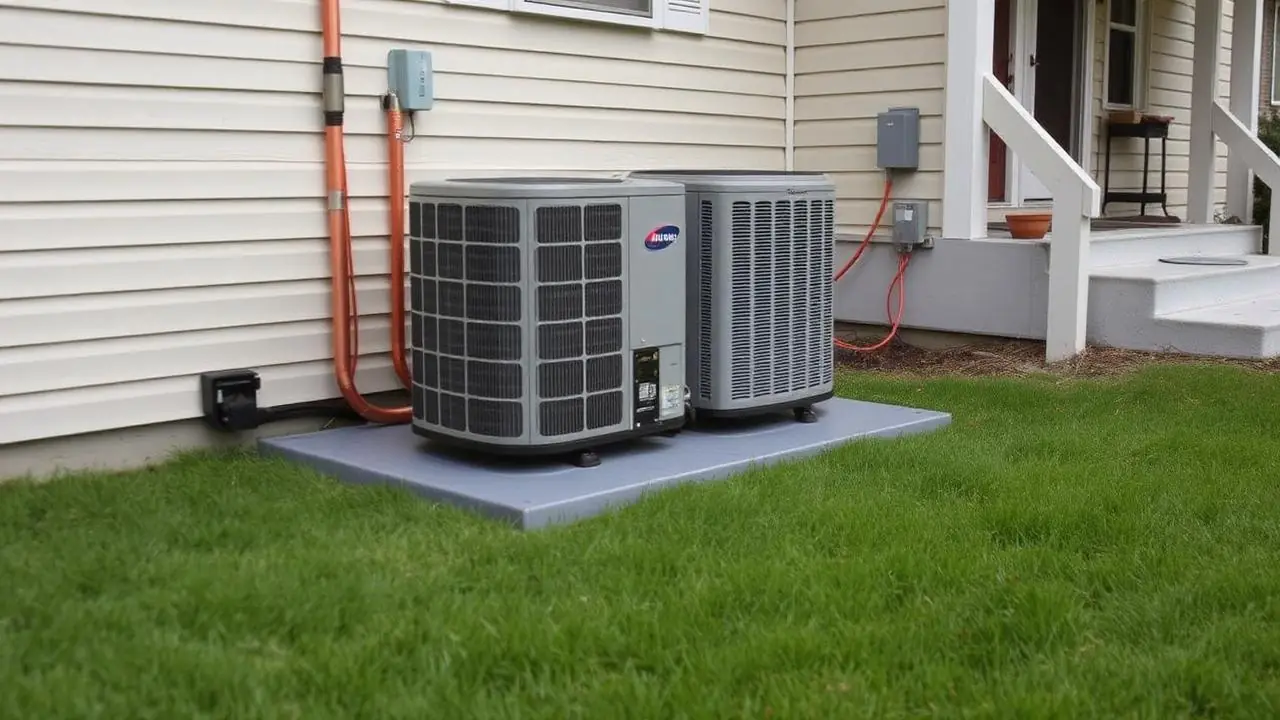
We recover the refrigerant from the old system properly, pull the old condenser and coil, and haul them out for recycling. The new pad gets set level — a condenser sitting crooked on settled ground is a compressor problem waiting a few years to happen.
Indoors, the new evaporator coil is set and sealed on the furnace, and the condensate drain gets pitched correctly with a trap and a safety switch. A drain that backs up over a finished ceiling is one of the most common and most avoidable callbacks in this trade.
The line set is either replaced or flushed and pressure tested, then the system is evacuated with a vacuum pump to pull moisture out before charge goes in. Refrigerant is weighed in, then verified with superheat and subcooling readings at operating conditions rather than by feel on the suction line. We check the disconnect and whip, set the thermostat up with you, and take temperature split readings at the supply and return before we call it done.
Permit and inspection requirements differ community to community around here, and we handle that side the way your building department asks. You'll get the model and serial information, the registered manufacturer warranty details, and a walkthrough of the filter size and change interval before we pull out of the driveway.
AC installation questions
How long does a central air replacement take?
A straight swap of condenser and evaporator coil on existing line set and ductwork is usually a one-day job. Adding a new line set, correcting a return that was always undersized, or moving the condenser adds time. We'll tell you which one yours is after we look at it, not after we start.
Do I have to replace the furnace at the same time?
Not always, but the indoor coil sits on top of the furnace and the blower has to move the right airflow for the new system. If your furnace is also near the end of its life, doing both at once saves a second round of labor. If the furnace has years left and the blower is right for the coil, we'll leave it alone and say so.
Is a higher SEER2 unit worth the money in Cleveland?
Modestly. Northeast Ohio has roughly a three-month cooling season, so the annual hours that efficiency gets to work on are limited. Stepping from an older unit to a current baseline system is a real savings. Stepping from baseline to the top tier usually adds thousands upfront to save a small amount on three months of bills, and the payback often runs past the equipment's life.
What size air conditioner does my house need?
It's a calculation, not a guess from square footage. We look at the actual conditioned area, window count and orientation, insulation levels, and duct capacity. Oversizing is the common mistake — an oversized unit cools fast, shuts off before it removes humidity, and leaves the house cold and clammy while cycling itself to death.
What comes with the installation?
Removal and recycling of the old equipment, a new pad and level set for the condenser, matched evaporator coil, new line set or a proper flush of the existing one, electrical disconnect and whip checked, refrigerant weighed in to spec, and a full startup with superheat and subcooling readings. Permit and inspection requirements vary by community and we handle that as your city requires.
Thinking about a new air conditioner?
Call and we'll look at the house, the ducts, and the numbers before anybody quotes a size.
Hours: Call for availability