Family-run since 2010 • Plumbing in Greater Cleveland since 1992
Sewer Line Repair & Replacement in Brunswick, OH
Last updated:
We put a camera in the line before anybody talks about digging. You should know what is actually wrong down there before you spend this kind of money.
Hours: Call for availability
Tell us what the line is doing
Tell us what the house is doing and we'll call you back to set a time. Hours: Call for availability.
How much does sewer line repair cost in the Cleveland area?
A spot repair on a short accessible section of lateral typically runs $2,500 to $6,000 in Greater Cleveland. A full lateral replacement from the house to the city main usually falls between $6,000 and $20,000, and driveway, sidewalk, or street crossings push it higher. That range is wide for a reason — a camera inspection tells you which end of it you are on.
Warning signs of a failing sewer line
A sewer lateral rarely fails all at once. It gives you months of hints first, and most homeowners read them as ordinary clogs because that is what they look like. Here is what we listen for when someone calls, and what each symptom usually means once we get a camera in the pipe.
Multiple fixtures slow or backing up at once
One slow sink is a branch drain. A toilet that bubbles when the washer drains, or a tub backing up when you flush, means the water has nowhere to go past the main. That is a sewer symptom, not a fixture symptom.
Sewage smell inside or along the foundation
Properly working drains are sealed by traps and vented to the roof. A persistent sewer odor in a basement or near the foundation wall usually means gas escaping through a crack or a separated joint below the slab.
A soggy or unusually green patch in the yard
A stripe of grass that stays wet after a dry week, or grows noticeably faster than the rest of the lawn, often traces the lateral. Leaking sewage is fertilizer. If it follows a line from the house toward the street, that is worth a camera.
Water in the basement floor drain
The floor drain is the lowest opening in the system, so it is where a blocked main shows first. Clear water can be a sump or condensate issue, but gray or dirty water coming up means the main is restricted downstream.
Backups that keep coming back
If the same line clogs every few months, the clog is not the problem. Something structural is catching debris — roots, a joint offset, or a section holding water. Cabling treats the symptom while the cause keeps growing.
Sinkholes, settling, or cracked slab areas
A broken sewer line washes soil into the pipe over time, and the ground above it settles. Depressions in a lawn or driveway that appear over a season sometimes point straight at a failed lateral underneath.
Camera inspection first — we diagnose before we quote
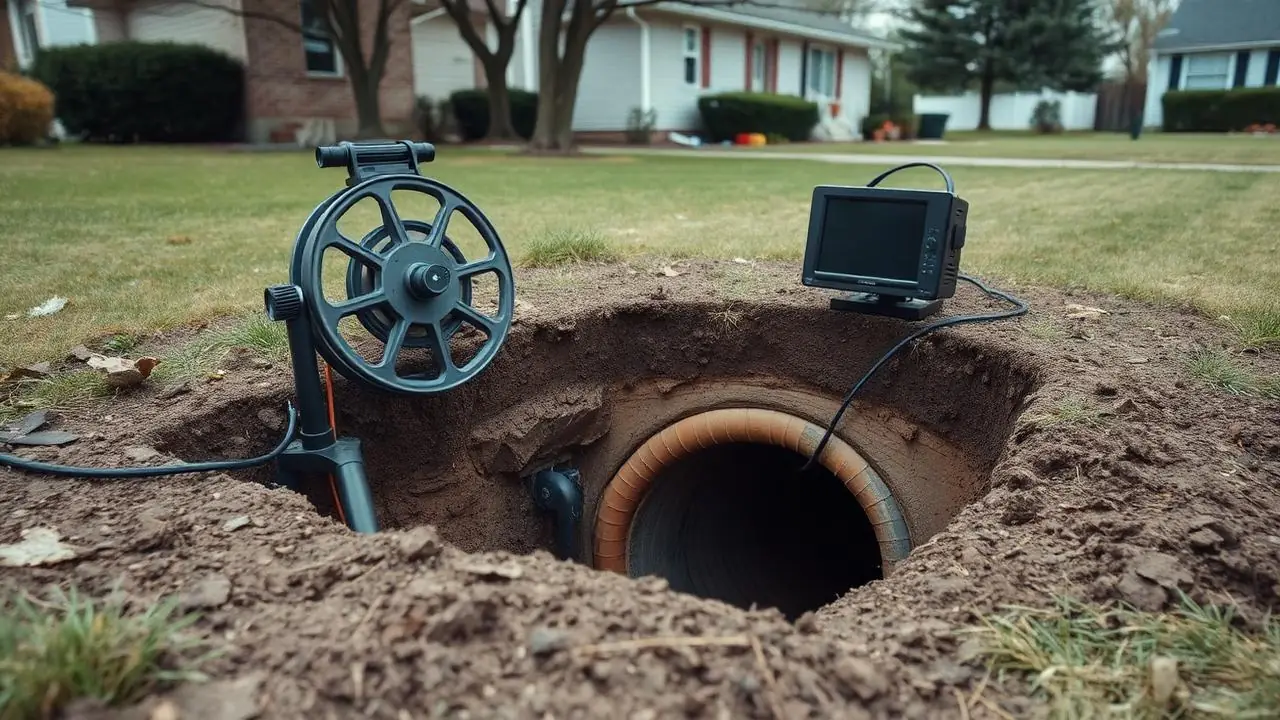
Nobody should quote a sewer job off a description over the phone. The pipe is four to eight feet underground, the material changes partway out to the street in a lot of these neighborhoods, and the difference between a $3,000 repair and a $15,000 replacement is usually thirty feet of pipe you cannot see. So we run the camera first.
The camera goes in through an accessible cleanout — often a cast-iron fitting in the basement floor or an exterior cleanout near the foundation. If the line is fully blocked, we cable it open enough to get the camera through, because a lens underwater shows you nothing. From there we push out toward the city main and watch what the pipe does: where the material changes, where joints have offset, where roots come in, and whether water is standing anywhere it should be flowing.
A locator on the camera head marks the depth and the position on the surface, so if there is a defect at 42 feet we can paint the spot in the yard and tell you how deep it sits. That single number changes the price more than almost anything else. Four feet deep in open lawn is a different job than seven feet under a concrete drive.
You get to watch the screen with us. We will point out what is normal wear on sixty-year-old pipe and what is an actual failure, and we would rather you see the difference yourself than take our word for it. If the line turns out to be sound and the problem was a soft clog, we will tell you that too and you will have paid for a cable and a camera instead of a sewer project.
Repair, spot repair, or full replacement
Most sewer conversations get framed as fix it or replace it. There is an honest middle, and for a lot of houses around here it is the right answer.
| Approach | When it fits | What to know |
|---|---|---|
| Cabling & maintenance | Fine root intrusion at one or two joints, pipe walls otherwise sound | Lowest cost, needs repeating on a schedule. A reasonable plan for years if the camera backs it up, not a fix if the pipe is failing. |
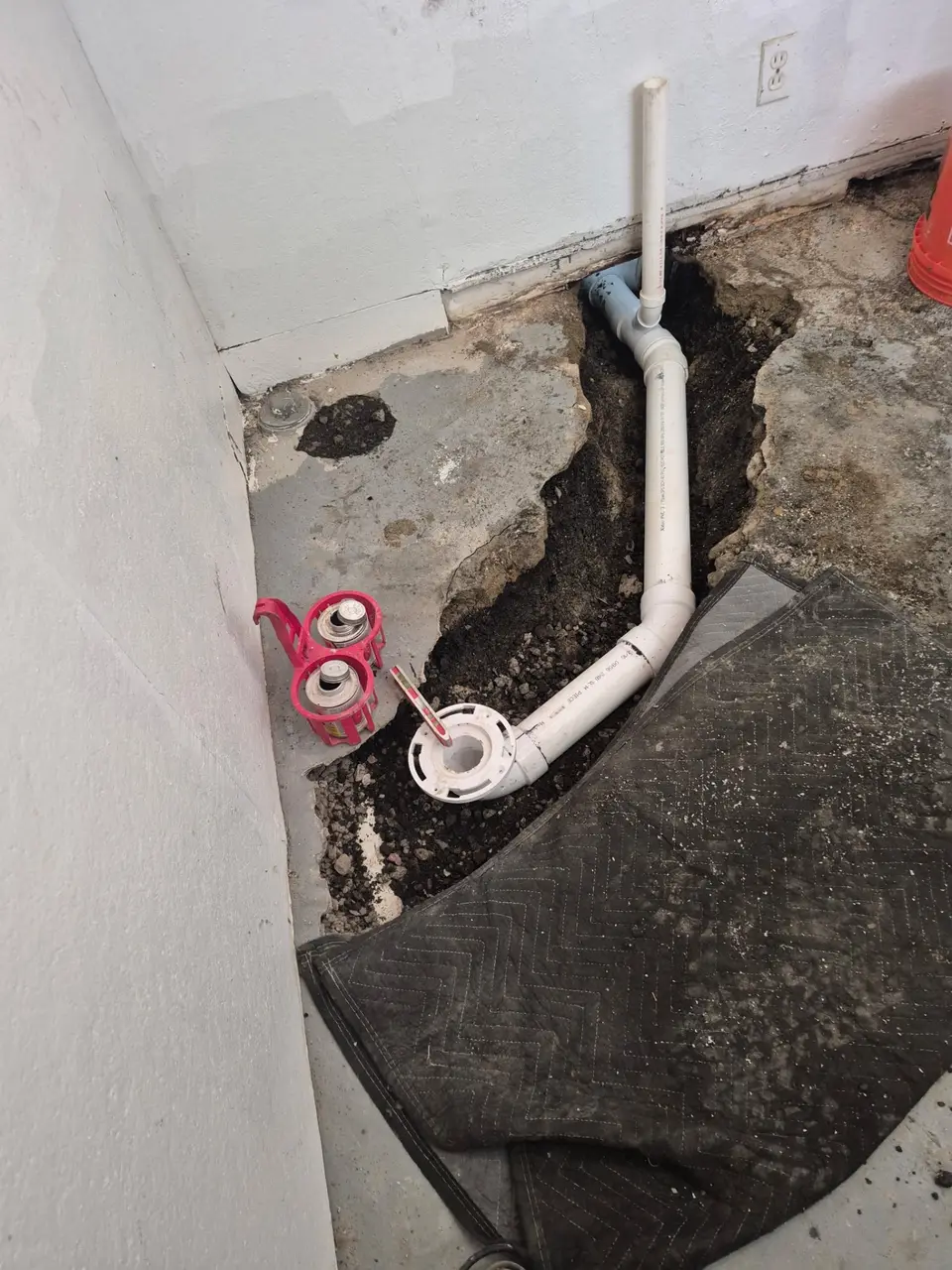
| Spot repair | One localized defect — a crushed section, a separated joint, a short belly | Dig one trench, cut out the bad section, splice in new PVC. Far cheaper than a full line, and the rest of the pipe keeps doing its job. |
| Full replacement (open cut) | Multiple failures along the run, collapsed pipe, or a line at the end of its life | New lateral end to end with proper slope. Most disruptive and most expensive, but it resets the clock for decades. |
| Trenchless methods | Sound host pipe, consistent diameter, access pits available at both ends | Saves the driveway and the landscaping when the conditions are right. Not possible on a collapsed or badly offset line — the camera decides, not the sales pitch. |
The reason we push spot repair when it fits is simple: a sixty-year-old clay lateral is not uniformly bad. Usually one joint under a maple tree took the abuse and the rest of the run is fine. Replacing all of it because one section failed is money spent on pipe that had twenty years left in it.
The flip side is that we will not sell a spot repair to buy peace of mind on a line the camera shows failing in four places. That job comes back, and it comes back after you have already paid for a trench. When the footage says replace, we say replace.
Tree roots and clay pipe in pre-1970s Northeast Ohio homes
If your house went up before about 1970 in Brunswick, Parma, Strongsville, or the older parts of Medina, there is a good chance the lateral out to the street is vitrified clay in short sections with mortared or gasketed joints. Clay itself holds up remarkably well underground — we pull up pipe from the 1950s that is still structurally fine. The joints are the weak point.
Our freeze-thaw cycle works on those joints every winter. The ground heaves, the sections shift a fraction of an inch, and a hairline gap opens. That gap leaks a little warm, nutrient-rich water into the surrounding soil, which is exactly what a tree root is looking for. Roots find the gap, thread through it, and fan out inside the pipe into a mat that catches paper and grease. Silver maples and willows are the worst offenders, and the tree lawns in these neighborhoods are full of them.
You also see Orangeburg on some 1950s and 60s houses — a tar-impregnated fiber pipe used when other materials were scarce. It deforms into an oval under soil load and eventually delaminates. There is no repairing Orangeburg. If the camera shows it, we are talking about replacement and it is worth budgeting for.
Bellies are the other common finding. Soil settles unevenly over decades, a section sags, and waste water stands in the low spot instead of flowing. Solids drop out of the standing water and build up. The homeowner experiences that as a main line that clogs every spring, which is why we point people toward drain cleaning first and a camera second. If the same line keeps clogging, the cable is treating a symptom of a pipe that has moved.
If your basement is taking on sewage right now, that is a different call — go to emergency plumbing and stop running water in the house until somebody gets there. The camera and the planning come after the backup is under control.
What neighbors say
Reviews go here as they're verified. We don't post anything we can't trace back to a real address and a real invoice.
Sewer line questions
Does homeowners insurance cover sewer line replacement?
Usually not. A standard policy covers sudden water damage inside the house, not the buried lateral or the excavation to reach it. Many carriers sell a service line endorsement for a modest yearly amount that does cover the pipe, and some cities offer a low-cost line protection program on the water bill. Check your declarations page for a service line endorsement before you assume either way.
How long does a sewer line replacement take?
A spot repair on an accessible section is often a one-day dig. A full lateral replacement from the house to the city main is typically two to three days depending on depth, driveway or sidewalk crossings, and how the utility locates come back. Weather and the locate window move the schedule more than the digging does.
Will you have to tear up my yard and driveway?
For an open-cut repair, yes, we dig a trench over the failed section, and we tell you exactly where before we start. Trenchless methods can sometimes avoid most of that, but they need a sound host pipe and access pits at both ends, so they are not an option on a fully collapsed line. The camera inspection is what tells us which methods are actually on the table.
Who owns the sewer line — me or the city?
In most communities around here the homeowner owns the lateral from the house out to the connection at the city main, including the portion under the tree lawn and street. Rules differ by municipality, and a few have programs that share the cost past the property line. We can tell you what we find and where the failure sits so you can call your building department with real information.
Can cabling the line hold me over for a while?
Sometimes, honestly. If the camera shows fine root hair at a joint and the pipe walls are otherwise sound, cabling once or twice a year can keep a line working for years. If it shows a belly holding standing water, a separated joint, or a crushed section, cabling only buys weeks and you should be planning the repair instead of paying for the same visit every few months.
Same line backing up again?
Call and describe what's happening. We'll camera the line and show you what's down there before anyone talks about digging.
Hours: Call for availability