Family-run since 2010 • Plumbing in Greater Cleveland since 1992
Water Heater Repair & Replacement in Brunswick, OH
Last updated:
No hot water, not enough of it, or a puddle on the basement floor. Tell us what the tank is doing and we'll tell you straight whether it's a part or a replacement.
Hours: Call for availability
Tell us about your water heater
Tell us what the house is doing and we'll call you back to set a time. Hours: Call for availability.
A water heater is the appliance nobody thinks about until it quits
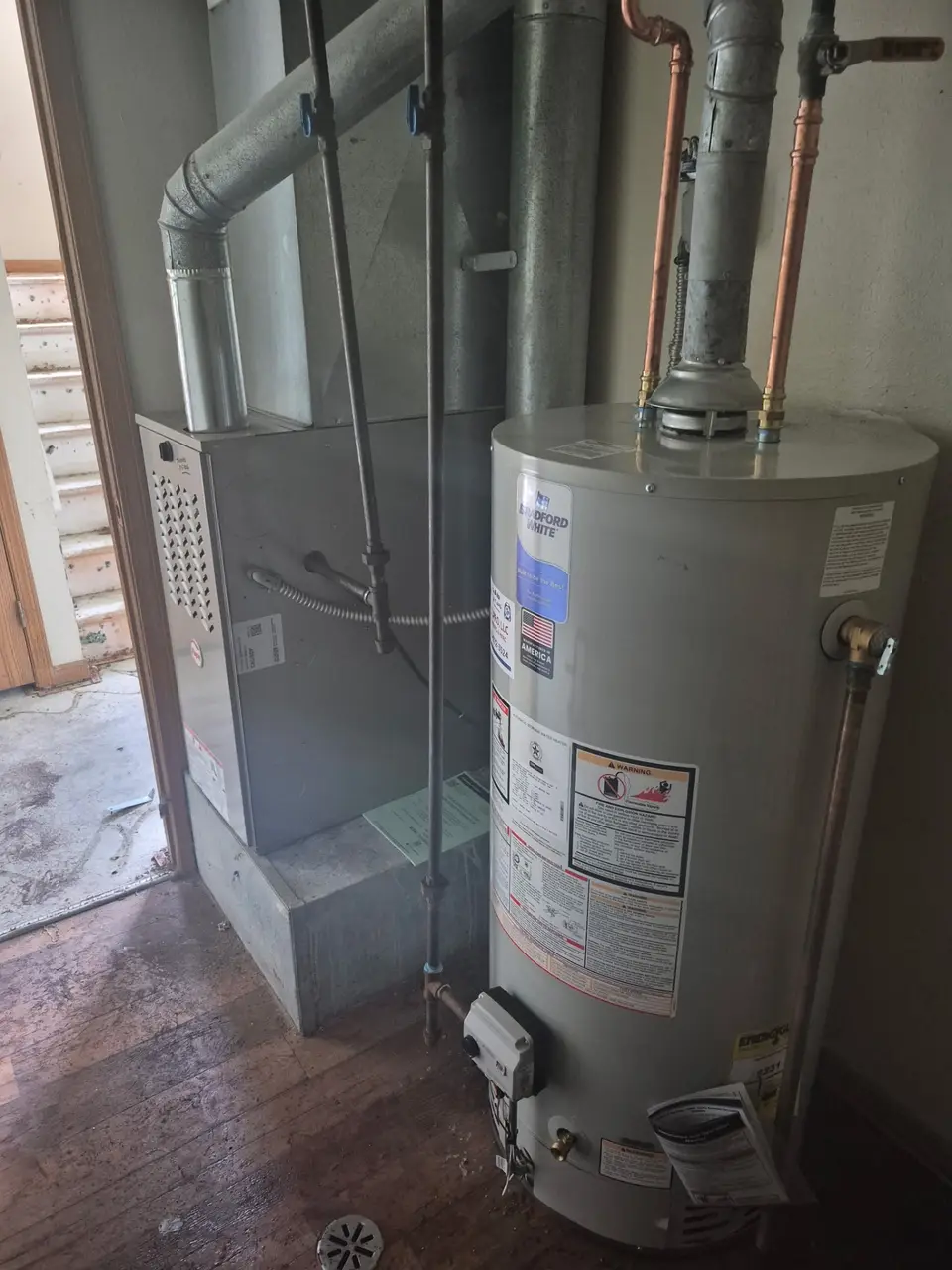
Most of the tanks we see in Brunswick, Medina, Strongsville, and North Royalton are 40- or 50-gallon gas units sitting in a basement corner next to the furnace, installed somewhere between eight and eighteen years ago. They run without a single complaint until the morning the shower goes cold, and by then the homeowner has about a day to make a decision they've never had to think about before.
We'd rather you make that decision with real information. Some faults are a thirty-dollar part and twenty minutes. Some are a tank that has already rusted through and is quietly wetting the floor behind it. The difference matters, and it isn't hard to tell once somebody looks at it. What follows is how we sort the two, what each side generally costs in this market, and how we size and install a replacement when that's the honest answer.
If the tank is actively leaking and water is spreading across the basement, shut the cold supply valve on top of the unit and call. That situation is covered on our emergency plumbing page, including where the shutoffs typically are in Northeast Ohio basements.
Water Heater Repair
A tank under about ten years old with a good shell is usually worth repairing. Parts are available, the labor is straightforward, and you get years back for a fraction of a new install. Here's what we actually see and what each one means.
How much does water heater repair cost in the Cleveland area?
Most water heater repairs in Greater Cleveland run $150 to $500. A thermocouple, pilot assembly, or electric element and thermostat sits at the low end. A gas control valve, a full flush with a new anode rod, or replacing corroded connections and a relief valve sits at the top. Those are market-typical ranges, not a quote — the fault decides the number.
No hot water at all
On a gas unit that usually means the pilot is out, the thermocouple has failed, or the gas control valve is done. On electric it is normally a tripped high-limit reset, a bad upper element, or a failed thermostat. All of those are diagnosable in one visit, and most are worth fixing on a tank that still has years left.
Not enough hot water
If you used to get two showers and now you get half of one, the lower element or the dip tube is the usual suspect on electric, and sediment on the tank bottom is the usual suspect on gas. Sediment insulates the burner from the water, so the burner runs longer and heats less. A flush helps if we catch it early.
Leaking tank vs. leaking fitting
This is the honest one. Fittings, valves, and the relief line can be repaired. If the steel tank itself is weeping at the bottom seam, the glass lining has failed and the tank is finished. Nobody welds a residential water heater back to life. If you see rusty water pooling under the center of the unit, plan on replacement.
Pilot, thermocouple & ignitor faults
A pilot that lights and drops out is almost always a weak thermocouple or a dirty thermopile. On newer sealed-combustion units, a blocked air intake screen causes the same symptom. Both are inexpensive parts. If the gas control valve itself has failed on a ten-year-old tank, the part cost starts pushing toward replacement math.
Element & thermostat failure (electric)
Electric tanks have two elements and two thermostats. When the upper fails you get no hot water; when the lower fails you get a little then run cold fast. Elements are cheap, but a tank that has scaled heavily around the element is telling you about its overall condition, so we check the rest before we quote.
Rumbling, popping & rusty water
Popping is steam bubbles escaping from under a sediment layer. Rusty hot water usually means the anode rod is spent and the tank lining is next. Neither one is an emergency this minute, but both are the tank telling you how much life is left.
The one rule we don't bend: a leaking tank means replacement, not repair. We get asked about epoxy, tank sealers, and welding, and the answer is no every time. A residential water heater is a steel tank with a thin glass lining. Once the water has found its way through the steel, the whole shell is corroding from the inside, and a patch just moves the failure a few weeks out — usually to the middle of the night when nobody is home to hear it. We'd rather set you up with a new unit on your schedule than come back for a flooded basement on ours.
The other honest line is age. If a ten- or eleven-year-old tank needs a $400 gas control valve, we'll say plainly that the money is better spent on a new unit. That's not an upsell, it's arithmetic: you'd be putting a third of a replacement cost into a tank that's already at the end of its expected run.
Water Heater Replacement & Installation
When the tank is done, the job is to get the sizing, fuel type, and code items right the first time so the next twelve years are boring.
How much does a new water heater cost installed in Northeast Ohio?
A standard 40- or 50-gallon gas tank installed in Greater Cleveland typically runs $1,600 to $2,800. Electric tanks usually land a little lower, power-vent units higher, and a tankless conversion generally starts around $4,500 once gas line and venting work is included. Those are market-typical ranges. Venting, code upgrades, and access drive the real number.
Sizing the tank to the house
Sizing is about first-hour delivery, not just gallons. A 40-gallon gas tank recovers fast enough for two people and a normal morning. Three or four people with staggered showers want 50 gallons. Five or more, or a house with a big soaking tub and a laundry running at the same time, is a 75-gallon or a high-recovery unit conversation.
Electric tanks heat slower, so we generally step up one size when the house is all electric. If two teenagers shower back to back on an electric 40, somebody is getting a cold rinse. Going to a 50 or 66 costs a little more upfront and solves it for good.
We also look at what's physically possible. Older Brunswick and Parma basements have low joists, tight stair turns, and utility rooms built around the original tank. There is no point specifying a taller unit that won't clear the header or fit down the stairs, so we measure before we order.
Gas vs. electric in this area
If the house already has natural gas at the tank, staying gas is almost always the cheaper long-run choice here. Gas recovery is faster, and Ohio gas rates keep the operating cost below an equivalent electric tank for most families.
Electric makes sense when there's no gas service, when the venting situation is a problem, or when the tank is going somewhere a flue can't reach. Modern electric tanks are reliable and simple — two elements, two thermostats, nothing to vent. The tradeoff is recovery speed and a higher monthly cost per gallon heated.
A note on tankless, honestly: it's real technology and it works, but Northeast Ohio incoming water is cold in January, which cuts the flow rate a tankless unit can hold at temperature. Most conversions also need a larger gas line and new stainless venting, which is where the budget goes. If you want endless hot water and you have the gas capacity, we'll install it and it'll serve you well. If your goal is the best hot water per dollar, a properly sized tank still wins in this climate.
What the installation includes
| Item | What it means |
|---|---|
| Removal & haul-away | Old tank drained, disconnected, carried out, and recycled. You don't end up with a rusted tank sitting by the tree lawn. |
| Expansion tank | Many area homes have a closed system because of a check valve or pressure reducing valve at the meter. Heated water has to expand somewhere, and an expansion tank keeps that pressure off your new heater and your fixtures. |
| Drain pan & discharge | A pan piped to a floor drain where the location calls for it, so a future leak goes to the drain instead of across a finished basement. |
| T&P relief line | The temperature and pressure relief valve gets a proper full-size discharge line terminating where it should. This is the single most important safety device on the tank and the one most often done wrong. |
| Venting | Flue connection checked for slope, size, and shared-vent condition with the furnace. If the old vent was undersized or rusted, we correct it rather than reuse it. |
| Permit & inspection | Requirements differ from one community to the next around here. We follow whatever the local building department asks for on the job and handle the paperwork side with you. |
A standard swap is usually a half-day job. We shut the water and gas, drain the old tank, get it out, set and level the new one, make up the connections, install the code items, fill and purge the air out of the lines, then light it and check the flue with a draft test before we leave. You'll get hot water the same afternoon in most cases.
Where jobs run longer is when the old install was wrong. Undersized venting, a gas line teed off something it shouldn't be, no shutoff, a corroded nipple that fights coming off — those add time. We'd rather fix them than build a new tank on top of an old mistake, and we'll tell you what we found and what it costs before we do it.
Before we leave we set the thermostat to 120 degrees, which is hot enough for a household and cool enough to avoid scalding and slow down scale buildup. We'll show you the shutoff, the drain valve, and how to flush it yourself once a year if you're the kind of homeowner who likes to keep up with it.
What neighbors say
Reviews go here as they're verified. We don't post anything we can't trace back to a real address and a real invoice.
Water heater questions
How long should a water heater last around here?
Ten to twelve years is typical for a standard gas or electric tank in Northeast Ohio. Our water is moderately hard, so sediment builds in the bottom of the tank and the anode rod gets eaten faster than the label suggests. Flushing once a year and swapping the anode around year five gets some tanks past fifteen. Past twelve, we start planning instead of repairing.
My water heater is leaking. Can it be repaired?
It depends where the water is coming from. Drips at the cold inlet, the hot outlet, the drain valve, or the temperature and pressure relief line are fittings and are usually repairable. Water seeping from the bottom seam of the tank itself is corrosion through the steel, and there is no patch for that. A leaking tank gets replaced, and it should not wait.
How much hot water do I need for my family?
Rough working numbers: two people are usually fine on a 40-gallon gas tank, three to four people want 50 gallons, and five or more should look at 50 to 75 gallons or a high-recovery unit. Electric tanks recover slower, so bump one size up. Big soaking tubs and back-to-back morning showers push the sizing up too.
Is a tankless water heater worth it in Cleveland?
Sometimes. It saves standby energy and never runs out, but our incoming water is cold in winter, so the unit works harder to hit temperature and flow rates drop. Most homes also need a gas line upsize and new stainless venting, which adds real money to the install. If you have the gas capacity and you want endless hot water, it can make sense. If you just want hot showers for the least money, a good tank wins.
What does a water heater installation include?
Draining and hauling away the old unit, setting and leveling the new one, new flex connectors and shutoff if needed, a code-compliant temperature and pressure relief discharge line, venting checked and corrected, plus an expansion tank and drain pan where the situation calls for it. Permit and inspection requirements vary by community, and we handle that side the way your city requires it.
No hot water, or a tank that's on its last year?
Call and describe what it's doing. We'll tell you whether it's a part or a replacement before we come out.
Hours: Call for availability