Family-run since 2010 • Plumbing in Greater Cleveland since 1992
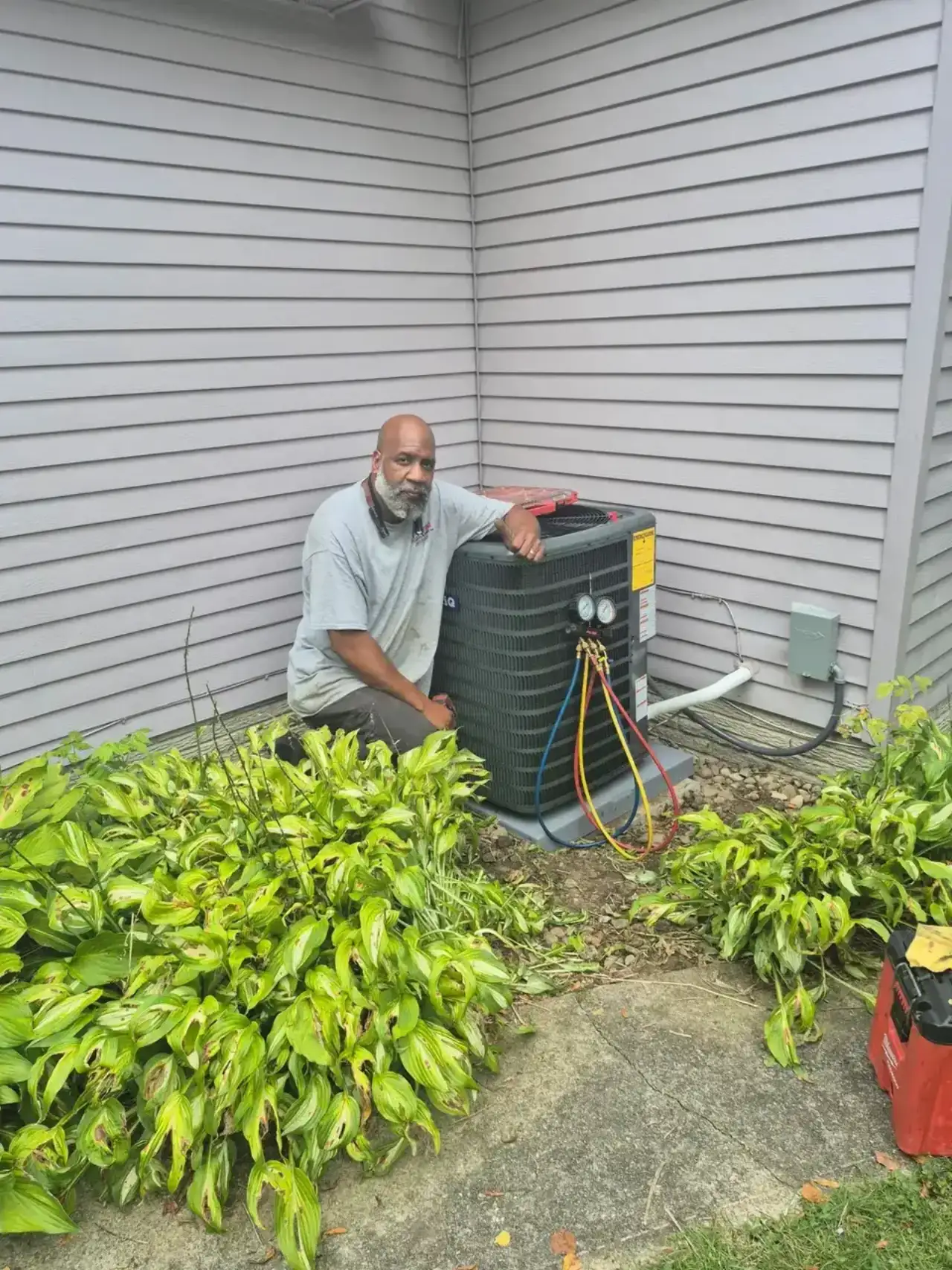
AC Repair in Brunswick & Greater Cleveland, OH
Last updated:
No cool air? Call a local Brunswick crew that answers. We'll diagnose what actually failed instead of dumping refrigerant in and driving away.
Hours: Call for availability
Tell us what your AC is doing
Tell us what the house is doing and we'll call you back to set a time. Hours: Call for availability.
How much does AC repair cost in the Cleveland area?
Most air conditioning repairs in Greater Cleveland run $150 to $650. A capacitor or contactor sits at the low end, a condenser fan motor in the middle, and refrigerant leak diagnosis with a repair and recharge at the top. Compressor and coil failures are a separate, much larger conversation. Those are market-typical ranges, not a quote — the fault decides the number.
Common AC problems we repair
Cleveland's cooling season is short but it comes on hard. Systems sit idle from September to May, and the first ninety-degree stretch is when the weak parts show themselves. Here's what actually fails on residential central air around here.
Running but not cooling
The most common call we get. Air moves through the vents, but it's the same temperature as the room. Nine times out of ten the outdoor unit isn't running, or it's running without the compressor engaging. Start by checking whether the condenser fan is spinning — if it isn't, that narrows things quickly.
Frozen evaporator coil
Ice on the indoor coil or on the copper line at the furnace means airflow or refrigerant is wrong. A dirty filter, a closed-off return, or low charge all cause it. Shut the cooling off and run the fan alone to thaw it before anyone touches it — running a compressor against an iced coil is how you kill it.
Refrigerant leak
Systems don't use refrigerant up. Low charge means a leak, usually at a flare fitting, a service valve, or a corroded spot on the evaporator coil. We locate it with electronic detection or dye rather than just charging and hoping. Older R-22 systems make this an expensive conversation, and we'll be straight about that.
Failed run capacitor
The cheapest common failure and a very frequent one in July. A weak capacitor can't get the compressor started, so you hear a hum and a click and then nothing. It's an inexpensive part and a quick swap. We check the microfarad reading rather than judging by the bulge on top.
Condenser or blower fan motor
If the outdoor fan doesn't spin, the system can't reject heat and the compressor overheats and shuts down on its internal overload. Indoors, a failing blower motor means weak airflow and a coil that ices. Both make a noise before they quit — a growl, a squeal, or a hum with no movement.
Short cycling
The unit kicks on for a couple of minutes, shuts off, and repeats. Causes range from an oversized system to a dirty coil, low charge, or a thermostat placed where the supply air blows across it. Short cycling wears a compressor out faster than anything else, so it's worth diagnosing rather than living with.
What to check before you call
A meaningful share of no-cooling calls turn out to be one of these five things, and every one of them is free to check. We'd rather you find it in ten minutes than pay us to find it in five.
1. Thermostat settings and batteries
Set to COOL, not AUTO-changeover confusion, and the setpoint several degrees below room temperature. Weak batteries make a thermostat behave strangely long before the display goes blank. Swap them first.
2. Both breakers
Central air has two circuits: the indoor air handler or furnace, and a separate double-pole breaker for the outdoor condenser. There's also usually a pull-out disconnect box on the wall next to the condenser. Check all of them.
3. Air filter
A clogged filter starves the coil of airflow, which drops coil temperature until it ices over and stops cooling entirely. If the filter looks gray and matted, replace it. This one causes more summer service calls than anything else on the list.
4. Iced coil — shut it off
If you see frost on the copper line at the furnace or ice on the coil, turn cooling OFF and the fan ON. Let it thaw for several hours. Running the compressor against an iced coil sends liquid refrigerant back to it and can destroy it outright.
5. Vents, returns, and the outdoor unit
Open the supply registers, keep furniture off the returns, and clear leaves, grass clippings, and shrubs at least a foot back from the condenser. A unit that can't breathe can't reject heat.
Repair or replace?
Three things decide it, and none of them is a sales pitch. Run your unit against these and the answer is usually obvious.
| Factor | Lean repair | Lean replace |
|---|---|---|
| Age of the system | Under 12 years and running well otherwise | Over 15 years, or an R-22 system of any age |
| Cost of the repair | Under about a third of replacement cost | More than half of replacement cost |
| Breakdown frequency | First real failure in years | Second or third call in two seasons |
If the numbers point toward a new system, here's what that job involves and what it costs: AC installation and replacement. If they point toward repair, we'll fix it and you'll get more seasons out of it.
AC repair questions
Do you service my AC brand?
Yes. Residential central air is a small set of the same components under different badges — compressor, condenser fan, capacitor, contactor, metering device, evaporator coil. We work on Carrier, Trane, Lennox, Goodman, Rheem, American Standard, Bryant, York and the rest. Parts availability varies more by age than by brand.
How fast can you come out?
Call and we'll tell you where you sit in the schedule that day. We're a small family crew, not a call center, so you'll get a straight answer about when we can be there rather than a window nobody intends to keep. Hot-weather stretches fill up fast, so calling early in the day helps.
My AC is blowing but the air isn't cold. What's wrong?
That usually means the indoor blower is running but the outdoor unit isn't doing its job — a failed capacitor, a tripped breaker on the condenser circuit, a bad contactor, or low refrigerant from a leak. It can also mean the evaporator coil has iced over and airflow is passing over a block of ice. Shut the cooling off, leave the fan on, and call.
Should I just add refrigerant every summer?
No. A sealed system doesn't consume refrigerant — if it's low, it's leaking somewhere. Topping it off each year means paying repeatedly for gas that ends up in the atmosphere while the leak gets bigger. We'd rather find the leak, tell you what the repair costs, and let you weigh that against the age of the unit.
Is it worth repairing an older air conditioner?
Under about ten years, usually yes — capacitors, contactors, and fan motors are ordinary parts. Past fifteen, especially on an R-22 system where refrigerant costs a fortune, a big repair is often money thrown at a unit that's going to fail again. We'll give you both numbers and let you decide.
House not cooling down?
Call and tell us what the unit is doing. We'll diagnose it and give you the number before we turn a wrench.
Hours: Call for availability