Family-run since 2010 • Plumbing in Greater Cleveland since 1992
Sump Pump Installation & Repair in Brunswick, OH
Last updated:
Clay soil, a wet spring, and a basement that was never meant to stay dry on its own. We size the pump for the pit and the water, not for the shelf it came off.
Hours: Call for availability
Tell us what it's doing
Tell us what the house is doing and we'll call you back to set a time. Hours: Call for availability.
What does a sump pump cost installed in the Cleveland area?
A standard sump pump replacement in Greater Cleveland typically runs about $500 to $1,100 installed, depending on horsepower, cast iron versus plastic, and whether the check valve and discharge need work. A battery backup system adds roughly $900 to $2,000. Those are market-typical ranges — the pit and the discharge decide the real number.
Why sump pumps fail in Northeast Ohio
The ground under most of Medina County and the southern Cleveland suburbs is heavy clay. Clay doesn't drain — it holds water and moves it sideways along the path of least resistance, which is usually the gravel backfill somebody dropped against your foundation when the house was built. Every spring thaw and every three-inch rain in April sends that water straight to the footer drain and into your pit.
That's a different duty cycle than a pump in sandy soil sees. A pump rated for intermittent use gets run near-continuously for weeks, and it ages in dog years. Add the older basements around here — block walls, footer tile that's half silted in, pits cut small because the original house had no pump at all — and you get pumps failing at seven years instead of fifteen.
We look at the whole path, not just the pump: how fast the pit refills, whether the check valve holds, whether the discharge is pitched and gets water far enough from the foundation, and whether your downspouts are quietly feeding the problem. Fixing a pump that's failing because of the discharge line is a repair you'll be making again.
Repair or replace?
Worth repairing
A pump under about five years old with a bad float switch, a failed or backwards check valve, a plugged weep hole, or a discharge line that froze at the outlet. Those are parts and labor on a motor that still has life in it, and the fix usually costs a fraction of a new install. Gravel in the impeller falls here too — clean it, clear the pit, and it runs.
Time to replace
Over seven years old, seized or humming motor, rust through the housing, or a pump that simply can't keep up with what the pit takes in. We also replace undersized pumps outright — a 1/3 horsepower unit fighting a high water table will die on schedule no matter how many switches you put on it. Cast iron housings shed heat better and last longer than plastic in a hard-cycling pit.
One thing we won't do is repair a nine-year-old pump in March and let you think you're covered. If it's at the end, you'll hear it plainly, with the price of both options so you can decide.
Battery backup systems — the honest pitch
The argument for a backup pump is simple and it isn't a sales line: the storms that fill your pit are the same storms that knock the power out. A perfectly good primary pump is a paperweight during an outage, and an outage during heavy rain is exactly when a pit fills fastest. That's the whole case.
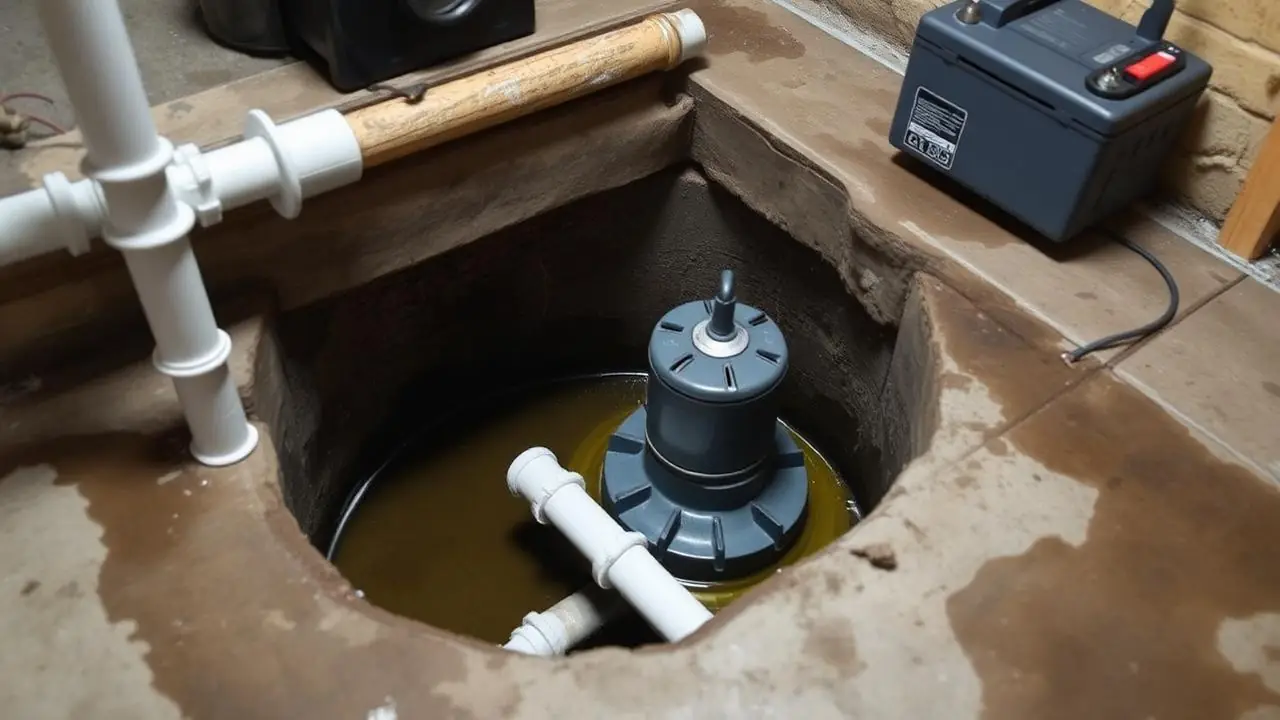
A backup system is a second pump sitting a few inches above the primary, wired to a deep-cycle battery that trickle charges off house power. When the primary can't run — power out, switch failed, motor dead — the backup takes over on its own. Real-world runtime depends on how hard it has to work, but a healthy battery generally carries a typical pit through the several hours most outages around here last.
What it isn't: a permanent solution to a wet basement, or something you install and forget. Batteries need replacing every three to five years, and a backup with a dead battery is worse than no backup because you thought you were covered. Water-powered backups exist too and never need a battery, but they only work on city water with decent pressure and they use a lot of it.
If your basement is finished, or you travel, or you've already had one flood, a backup pays for itself the first time it runs. If your basement is bare block with a floor drain and nothing on the floor, it's a reasonable thing to skip. We'll tell you which one you are.
Is your sump pump about to fail?
Go down and look at it on a dry day, not during the storm. Six things tell you where it stands.
It's over seven years old
Age alone is reason enough to plan a replacement. Pumps rarely give notice — they run fine until the one night they don't, and that night is always a storm. If there's a date on the housing and it starts with a 1, it's living on borrowed time.
It cycles constantly
A pump kicking on every couple of minutes in dry weather is either fighting a bad check valve or sitting in a pit too small for the water coming in. Either way it's burning through its duty cycle years early.
Rattling, grinding, or a loud hum
Rattling usually means the impeller is loose or chewing on gravel that washed into the pit. A hum with no water moving means the motor is energized but the impeller is jammed. Both are the pump telling you it's near the end.
It runs dry
A pump that keeps running after the pit is empty has a float stuck up, and a dry-running motor overheats fast. Tethered floats hang up on the pit wall or the discharge pipe constantly — that's the first thing to look at.
Visible rust or a stuck float
Rust flaking off the housing means the seals are going, and once water gets into the motor it's finished. Push the float up by hand: if the pump doesn't start immediately, the switch is the problem and switches fail more often than motors.
Water in the basement even though it ran
That's the clearest signal there is. Either the pump can't keep up with the volume, or the discharge line is plugged, frozen, or dumping somewhere the water finds its way back. Sizing and discharge both need looking at before next spring.
What neighbors say
Reviews go here as they're verified. We don't post anything we can't trace back to a real address and a real invoice.
Sump pump questions
How long does a sump pump last?
Seven to ten years is realistic for a decent pump in this area, and less if the pit is small and the pump cycles hard every spring. The motor is rated for a duty cycle, and Medina County clay makes it work past that a few weeks a year. If yours is over seven and you don't know its history, plan the replacement instead of waiting for the storm to pick the date.
Is a battery backup sump pump worth it?
In this area, yes — because the storms that fill your pit are the same storms that drop the power lines. A primary pump with no backup is fully dependent on FirstEnergy staying up during the exact hour you need it most. A backup system won't pump forever, but it buys you the several hours an outage usually lasts, which is normally the difference between a dry basement and a wet one.
Why does my sump pump run constantly?
Either water genuinely keeps coming in — high water table, a spring, or downspouts dumping right against the foundation — or the pump isn't clearing the pit. A missing or stuck check valve lets the discharge column fall right back in, so the pump pumps the same gallon over and over. That one is cheap to fix and it's killing the motor while you wait.
Can I replace a sump pump myself?
Plenty of homeowners do, and the pump swap itself isn't complicated. Where it usually goes wrong is the details: a check valve installed backwards, a discharge line that isn't pitched to drain, no weep hole so the pump air-locks, or a pit that needed a bigger pump than the box store sells. If you'd rather it just work through April, that's what we're for.
Water rising in the pit?
Call and describe what the pump is doing. If it's a switch we'll say so, and if it's done we'll say that too.
Hours: Call for availability