Family-run since 2010 • Plumbing in Greater Cleveland since 1992
Emergency Plumber in Brunswick & the Southern Cleveland Suburbs
Last updated:
Talk to a plumber, not a dispatcher.
Call now — if we can't get to you fast, we'll tell you straight.
Hours: Call for availability
What counts as a plumbing emergency
Not every plumbing problem needs somebody in the house tonight. A dripping faucet or a slow bathroom sink can wait for a regular appointment and cost you less. These six can't, because every hour they run costs you drywall, flooring, or a sanitation problem. We've been running these calls out of Brunswick, OH since 2010, with an owner who has worked these lines since 1992, mostly within twenty minutes of the shop.
Burst supply pipe
Copper or PEX that splits under pressure puts several gallons a minute into the house until somebody closes the main. It's the single most damaging thing that happens in a basement. Shut the water off first, then call — that order matters more than how fast we drive.
No water at all
Nothing at any fixture usually means a failed pressure tank or pump on a well, a closed or broken main valve, or a frozen service line. On city water in Brunswick or Parma, check with a neighbor first — a street main break is the utility's call, not ours.
Sewage backing up
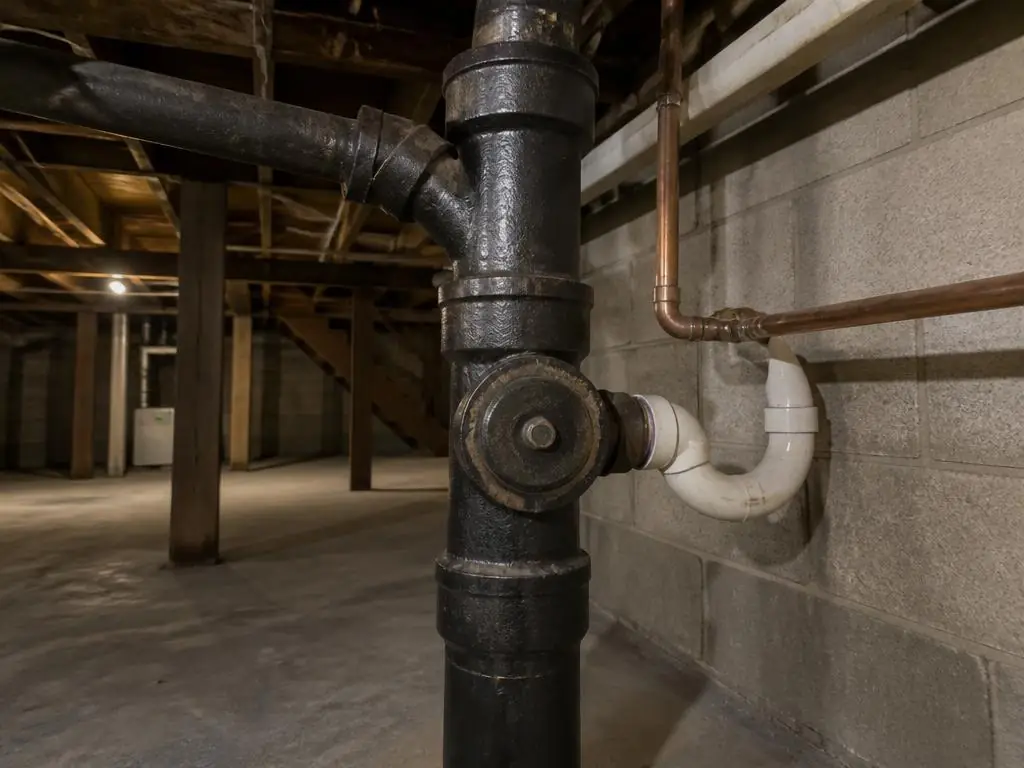
Wastewater rising in a floor drain, tub, or basement toilet means the lateral out to the street is blocked. Older clay and cast-iron laterals under mature trees are the usual culprits around here. Stop running water in the house immediately.
Major active leak
A supply line at a water heater, a failed washing machine hose, or a joint letting go in a finished ceiling. If you can isolate it at a stop valve, do that. If not, the main goes off. Standing water on a finished floor turns into a much bigger bill by morning.
Frozen pipes
Northeast Ohio does this to pipes running through rim joists, crawlspaces, and unheated garages. A frozen line that hasn't split yet is a repair you can still get ahead of; one that has split will announce itself the moment it thaws. Open the cabinet doors and leave a faucet dripping.
Sump pump failure in a storm
A pump that quits mid-storm gives you maybe an hour before water is over the basement slab. Common causes are a stuck float, a seized motor, a discharge line frozen or plugged outside, or simply a pump that ran past its service life. Backup pumps exist for exactly this night.
Shut it off first: where the valves are in a typical NE Ohio basement
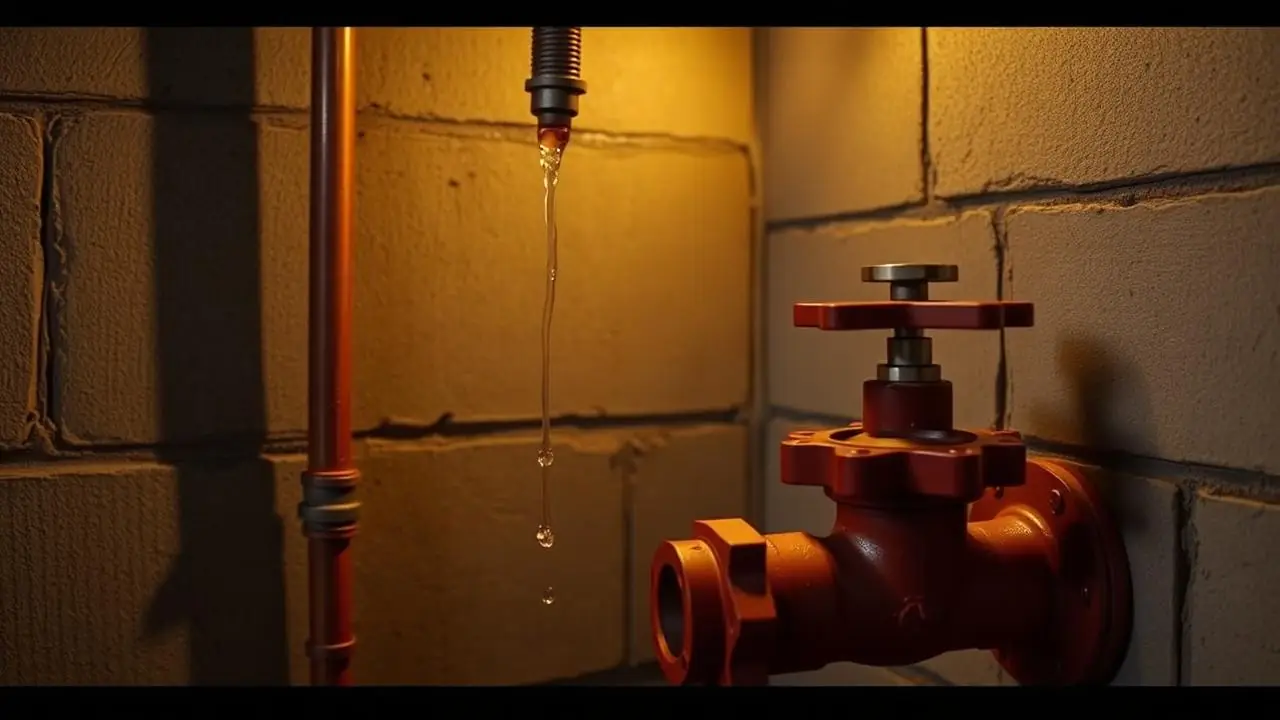
In most homes south of Cleveland, the main water shutoff is on the front basement wall — the side facing the street — within a few feet of where the copper comes through the block, usually just past the water meter. Turn it clockwise until it stops. That one valve stops almost every plumbing emergency from getting worse.
Finding the main water shutoff
Walk to the front of the basement and look low on the wall facing the street. You're looking for the meter — a brass or plastic body with a dial or a digital read — and a valve on either side of it. The one on the house side of the meter is yours. It's either a round wheel handle (a gate valve, common in houses built before the late 1980s) or a lever (a ball valve, standard in newer Brunswick and Medina construction).
A lever valve turns a quarter turn: handle in line with the pipe is open, handle crossways is closed. A wheel valve takes several full turns clockwise. Old gate valves seize and sometimes snap off the stem — if yours won't budge, don't force it with a pipe wrench in the middle of a flood. Go to the individual fixture stop instead, and put replacing that valve on the list for a calm weekday.
In houses with a crawlspace instead of a full basement, the shutoff is often in a utility closet, under the kitchen sink, or in the garage near the water heater. Find it now, tag it with a zip tie and a label, and show whoever else lives there. Two minutes on a Sunday afternoon is worth a great deal at two in the morning.
Shutting down a leaking water heater
A water heater has its own shutoff: the cold-water valve on top of the tank, on the inlet side (the pipe that isn't hot to the touch). Close it and the tank stops refilling, which stops the leak from being endless. Then kill the energy source — on a gas heater, turn the control knob on the front of the gas valve to OFF; on an electric heater, shut off its double-pole breaker in the panel. A tank that keeps heating with no water in it will destroy the elements or scorch the flue.
If water is coming from the tank body itself rather than a fitting, that heater is finished — the glass lining has failed and there is no repair. Drain what you can through the boiler drain at the bottom with a garden hose to the floor drain, and plan on a replacement. If it's dripping from the temperature and pressure relief valve on the side, that's a different problem and sometimes a fixable one, but never plug that valve.
What does an emergency plumber cost around Cleveland?
Emergency and after-hours plumbing calls in the Cleveland area typically start around $150 to $350 just to get a truck out at night or on a weekend, with the repair priced on top of that. Straightforward work often lands in the $250 to $800 range overall. Those are market-typical figures, not a quote.
Here's the honest framing: emergency calls carry a premium, and they should. Somebody is leaving the house at eleven at night, and the parts have to come off the truck rather than from a supply house that's closed. Any shop that claims there's no difference between a Tuesday morning appointment and a Saturday midnight call has simply buried the difference in the price of both.
What moves the number is access and scope. A split section of copper in an open basement ceiling is a short job. The same split behind finished drywall in a Strongsville colonial means opening the ceiling, and now there's drywall work behind us. A main line backup that cables clear from an accessible cleanout is one price; one that needs the cleanout dug up in the yard is another entirely.
You'll get the price before we start, and if we think the problem can safely wait until regular hours, we'll say so — that conversation costs you nothing and saves you the after-hours premium. We would rather tell you to shut a valve and sleep on it than take money for a call that didn't need to happen tonight.
What neighbors say
Reviews go here as they're verified. We don't post anything we can't trace back to a real address and a real invoice.
Emergency plumbing questions
How fast can you get here?
That depends on the day and where the trucks already are. What we will do is give you a straight answer on the phone — if we can be there shortly, we'll say so, and if the honest answer is that you should call somebody else tonight, you'll get that too. What we won't do is book you a window we already know we can't hold.
What should I do while I wait?
Shut the water off at the main, or at the fixture stop if the leak is isolated to one sink or toilet. If it's the water heater, close the cold inlet valve on top of the tank and kill the gas or the breaker. Move what you can off the floor, and put a fan on the wet area. Photos of the damage help you later with insurance.
Is a sewer backup an emergency?
Yes, and it's the one people wait on longest. Sewage coming up a basement floor drain means the main lateral is blocked and everything you send down the drains is coming back into the house. Stop using water — no laundry, no showers, no flushing — and call. Running a load of wash on a blocked main is how a small backup becomes a flooded basement.
Do emergency calls cost more?
After hours and weekends carry a premium, and any plumber telling you otherwise is building it in somewhere else. You'll hear the number before we start work. If the situation is stable — a leak you've shut off, a drain you can stop using overnight — we'll tell you plainly that waiting for regular hours will cost you less.
Water where it shouldn't be?
Shut the main off, then call. You'll get a plumber on the phone and a straight answer about when we can be there.
Hours: Call for availability